A flue is the vertical passage inside the chimney that carries smoke and carbon monoxide out of the house. When a homeowner says "i got my flue clogged," the blockage is usually a birds' nest, fallen clay-tile…
A flue is the vertical passage inside the chimney that carries smoke and carbon monoxide out of the house. When a homeowner says "i got my flue clogged," the blockage is usually a birds' nest, fallen clay-tile fragments, or hardened creosote, all common in the older brick chimneys of Temescal, Piedmont Avenue, and the Dimond District. Clearing a clogged flue starts with a Level 1 or Level 2 inspection under NFPA 211, then mechanical sweeping and, where a camera shows cracked tiles, a liner repair recommendation with photos of what the camera found.
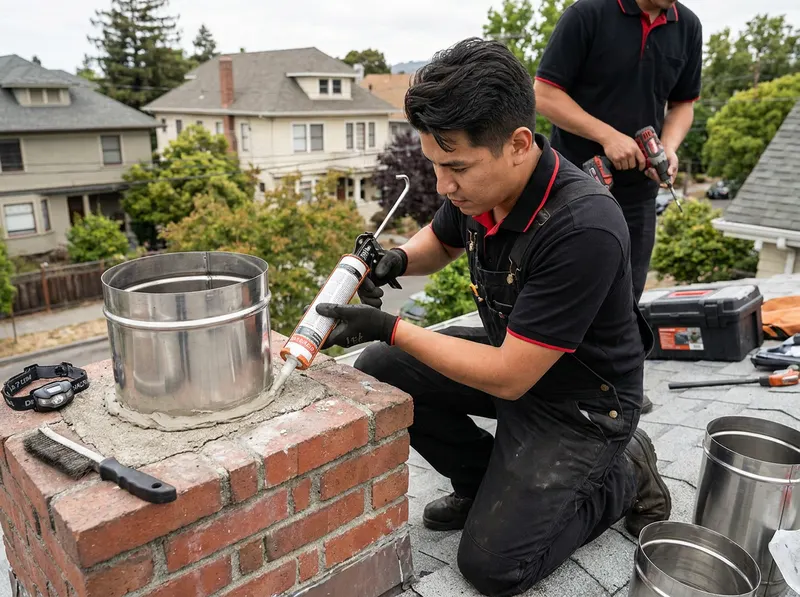
Three real options exist for a damaged flue. First, flue cleaning and clog removal restores draft when the liner itself is sound, this fits a chimney that smokes into the room only because a nest or debris is trapping smoke. Second, chimney relining replaces a cracked clay liner with a stainless steel liner rated to the appliance; this fits older Oakland Hills and Rockridge homes where the 1920s-1940s terra-cotta tiles have split, because a cracked liner lets heat and carbon monoxide reach the framing. Third, sealing off the flue permanently caps an unused chimney; when a homeowner says "i want to seal it off," this fits a decommissioned fireplace or a converted heating system, using a top-sealing cap and a base plate to stop rain, animals, and drafts. The trade-off is direct: clearing is cheapest and fastest but does nothing for a cracked liner, relining is the durable fix but costs the most, and sealing ends fireplace use entirely.
The crucial detail most estimates hide is that a clog and a cracked liner look identical from the firebox, smoke backing up. Only a camera run to the top of the flue separates the two, which is why a Level 2 inspection is the standard the Chimney Safety Institute of America (CSIA) references before any relining quote. A liner reline quote should list the liner diameter, the metal gauge, and the flue height in feet; a quote without those numbers is a guess. For a common 25-30 foot Oakland chimney, a stainless reline uses roughly that length of listed liner plus an insulation wrap and a top plate.
Homeowners in Grand Lake, Adams Point, Fruitvale, Montclair, and Laurel asking "is this a chimney company" get a straight answer: yes, flue work, inspection, and sweeping across Alameda County, with a free on-site estimate before any repair is scheduled. The estimate confirms whether the flue needs cleaning, relining, or a seal-off, and the written report includes the photos the camera captured. To reach the flue crew, call (341) 250-3865.
Every job gets a firm, written price after a free on-site visit.
Tell us about your flue repair & sealing job in Oakland and we'll send a clear, written quote, usually the same day.
 Flueshield Chimney Sweep