A leaking chimney in Oakland almost always traces to one of five sources: a cracked crown, failed flashing where the chimney meets the roof, deteriorated mortar joints, a missing or rusted cap, or porous brick that…
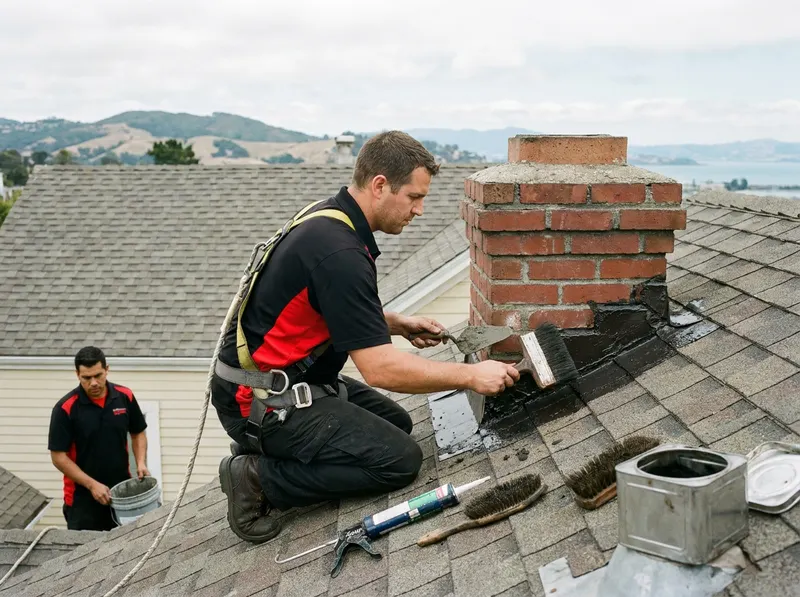
A leaking chimney in Oakland almost always traces to one of five sources: a cracked crown, failed flashing where the chimney meets the roof, deteriorated mortar joints, a missing or rusted cap, or porous brick that soaks up rain. The inspection isolates the real entry point instead of sealing everything and hoping. This matters because the fix for a cracked crown ($200-$650) is different from flashing replacement ($350-$1,200), and paying for the wrong one leaves the water coming in. A CSIA Level 2 inspection with a camera pass is used when the entry point is not obvious from the roof or the leak followed a chimney fire or roof work.
Waterproofing and repair solve different problems. Waterproofing applies a vapor-permeable siloxane or silane sealant to sound masonry, blocking liquid rain while letting existing moisture inside the brick escape. It is the right choice for older Oakland Hills and Rockridge homes with soft, absorbent brick that darkens after a storm but has no structural cracks. A film-forming paint or standard water sealer traps moisture and spalls the brick face over a freeze-thaw cycle, so vapor permeability is the specification that matters. If the leak comes from a cracked crown or open mortar joints, waterproofing alone will not stop it; the crack is repaired first, then the surface is sealed. If-then: if the brick is intact and only wicking water, waterproof it; if you can see a gap, crack, or rusted flashing, repair the source before any sealant goes on.
Oakland's leak season runs with the atmospheric-river rains from November through March, and the older housing stock across Temescal, the Dimond District, Grand Lake, and Piedmont Avenue often has crowns poured decades ago that have hairline-cracked. Flashing failures are common on the steep-roofed homes in Montclair and the Oakland Hills, where reroofing sometimes leaves the old chimney flashing in place. NFPA 211 treats a water-compromised chimney as a defect because a saturated flue and firebox degrade faster and can hide creosote and liner damage. A leak that reaches the firebox in Adams Point, Fruitvale, or Laurel is documented with photos so the homeowner sees the source, the repair, and the result rather than a vague verdict.
The process runs in four steps. First, the roof, crown, cap, flashing, and interior are inspected and photographed. Second, the water entry point is identified and the source repair and any waterproofing are quoted from that. Third, the repair is completed, most in a single 2-to-4-hour visit. Fourth, the sealed or repaired areas are photographed again for the homeowner's records. When no repair is needed, the report says so; an honest 'the brick is sound, seal it and you're done' verdict is a real outcome.
A free on-site estimate is available; the inspector comes out to look at the chimney, find the source, and price the fix. For scheduling, a Monday morning window is set the week prior, and the technician confirms a two-hour arrival window the day before rather than an all-day wait.
Every job gets a firm, written price after a free on-site visit.
Tell us about your chimney leak repair & waterproofing job in Oakland and we'll send a clear, written quote, usually the same day.
 Flueshield Chimney Sweep