A chimney rebuild is needed when mortar and masonry have deteriorated past the point where sealing or repointing will hold. In Oakland this shows up two ways. First, aging brick chimneys in older Rockridge, Temescal,…
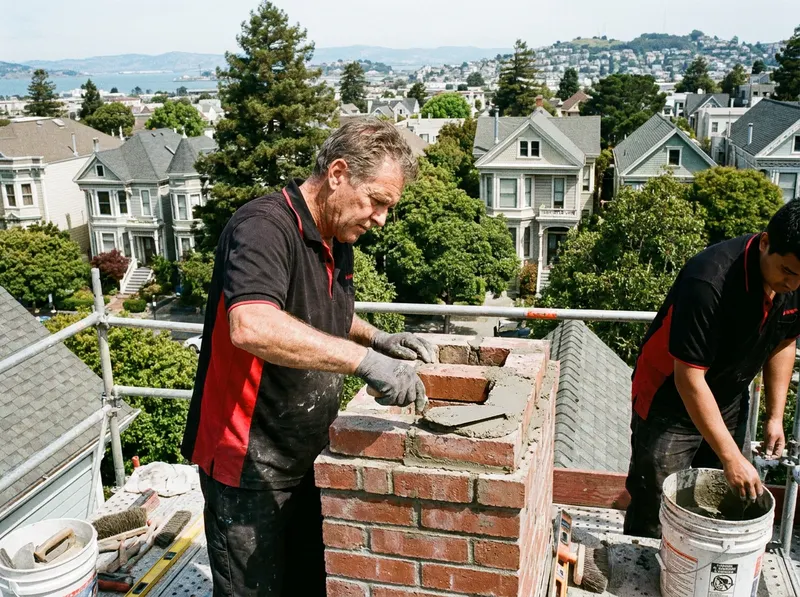
A chimney rebuild is needed when mortar and masonry have deteriorated past the point where sealing or repointing will hold. In Oakland this shows up two ways. First, aging brick chimneys in older Rockridge, Temescal, and Piedmont Avenue homes where the mortar has crumbled and the crown has cracked from decades of fog, rain, and freeze cycles in the Oakland Hills. Second, storm and impact damage, such as a falling limb from a redwood in Montclair that knocked about half the chimney down and put cracks in the rest of it. The scope of work depends on how much of the structure is sound.
Three levels of masonry work cover most Oakland chimneys. Chimney crack repair and repointing addresses hairline mortar-joint cracks and small crown cracks; the deteriorated mortar is raked out to about 3/4 inch and refilled, and this fits a chimney that is structurally sound but weathered. Chimney stone resets remove loose or displaced stones and rebed them in fresh mortar, which fits stone chimneys in the Dimond District and Laurel where individual stones have shifted but the core stack is intact. A partial or full chimney rebuild dismantles the failed section down to the last sound course and rebuilds it in matching brick or stone; this fits chimneys where more than a third of the structure is cracked, leaning, or spalling. The trade-off is straightforward: repointing costs a few hundred dollars and lasts years on otherwise sound masonry, while a full replacement of the chimney costs several thousand but resolves the underlying failure a patch would only hide.
Deciding between repair and rebuild follows the inspection. If a Level 1 inspection shows surface mortar loss with a solid crown and straight stack, crack repair holds. If a Level 2 inspection finds a cracked crown, spalled brick through multiple courses, a leaning stack, or a compromised flue liner, a rebuild is the durable fix. The Chimney Safety Institute of America (CSIA) recommends a Level 2 inspection whenever masonry damage is suspected or a chimney has been struck, because internal flue and liner damage is often not visible from the ground. All rebuild work maintains the NFPA 211 minimum 2-inch clearance from combustible framing and the required height of at least 3 feet above the roof penetration and 2 feet above anything within 10 feet.
A rebuild in the Oakland Hills or Grand Lake proceeds in a set order. First, the failed section is documented with photos and measured. Second, the chimney is dismantled to the last sound course and the debris removed. Third, new brick or stone is laid with a matching mortar mix. Fourth, a new crown is poured and the cap and flashing are reset. Fifth, the finished work is photographed for the homeowner's records. Homeowners in Adams Point and Fruitvale receive the same photo documentation whether the verdict is a full rebuild or a note that no rebuild is needed. Chimney masonry repair is not the same as a routine sweep; a sweep removes soot and creosote, while masonry work rebuilds the structure that contains the fire and vents the flue.
Every job gets a firm, written price after a free on-site visit.
Tell us about your chimney masonry & rebuild job in Oakland and we'll send a clear, written quote, usually the same day.
 Flueshield Chimney Sweep